Summary: Many managers still rely on vague praise or “blurry” critiques that leave employees guessing what to keep doing or change. AI can help leaders prepare clear, specific feedback without losing authenticity or trust.
Feedback works best when people know exactly what they did and why it matters.
Yet many managers fall into a familiar trap: vague praise like “Great job,” or unclear criticism like “Be more approachable.” These comments may sound supportive in the moment, but they rarely help people improve or repeat success.
We spoke with LifeLabs Learning Facilitator Kathy Pearce about why specificity is the key to effective feedback and how The Playing Cards Method™ helps managers turn blurry comments into clear, actionable conversations. She also shares how leaders can use AI as a helpful tool while still keeping feedback human, thoughtful, and trustworthy.
Q&A with Kathy Pearce
Q: Why is clarity essential in feedback, and what happens when it’s missing?
Kathy
We throw around “clear is kind” a lot, but clarity is also essential for improvement. If you don’t tell someone what they should keep doing or stop doing, they may not know how to improve or how to keep doing well.
When we aren’t clear, it’s often because we haven’t stopped to think about the behavior we’re reacting to. We lead with our judgment instead of with observable behaviors. That’s the piece that’s so important to focus on.
Q: Trust can be fragile, especially in hybrid and AI-supported workplaces. How does unclear feedback affect trust?
Kathy
Let’s start with praise. We’ve all heard the saying “praise in public,” but leaders often use what we call blurry praise. “You’re awesome,” or “Wow, are you a rock star!”
The problem is, the person receiving that praise might feel embarrassed, and the rest of the team may feel a little disheartened. They don’t know how to be as awesome or as much of a rock star as that person. When you’re clear about what that person did well, it gives other people a pathway to do the same thing.
The same thing happens with criticism. Leaders often avoid it or rush through it, especially in hybrid environments and AI-supported workplaces. It just becomes too difficult to spend the time
on a good conversation.
Over time, these things can damage trust.
Q: For someone new to the Playing Cards MethodTM, what is it, and why does it work so well?
Kathy
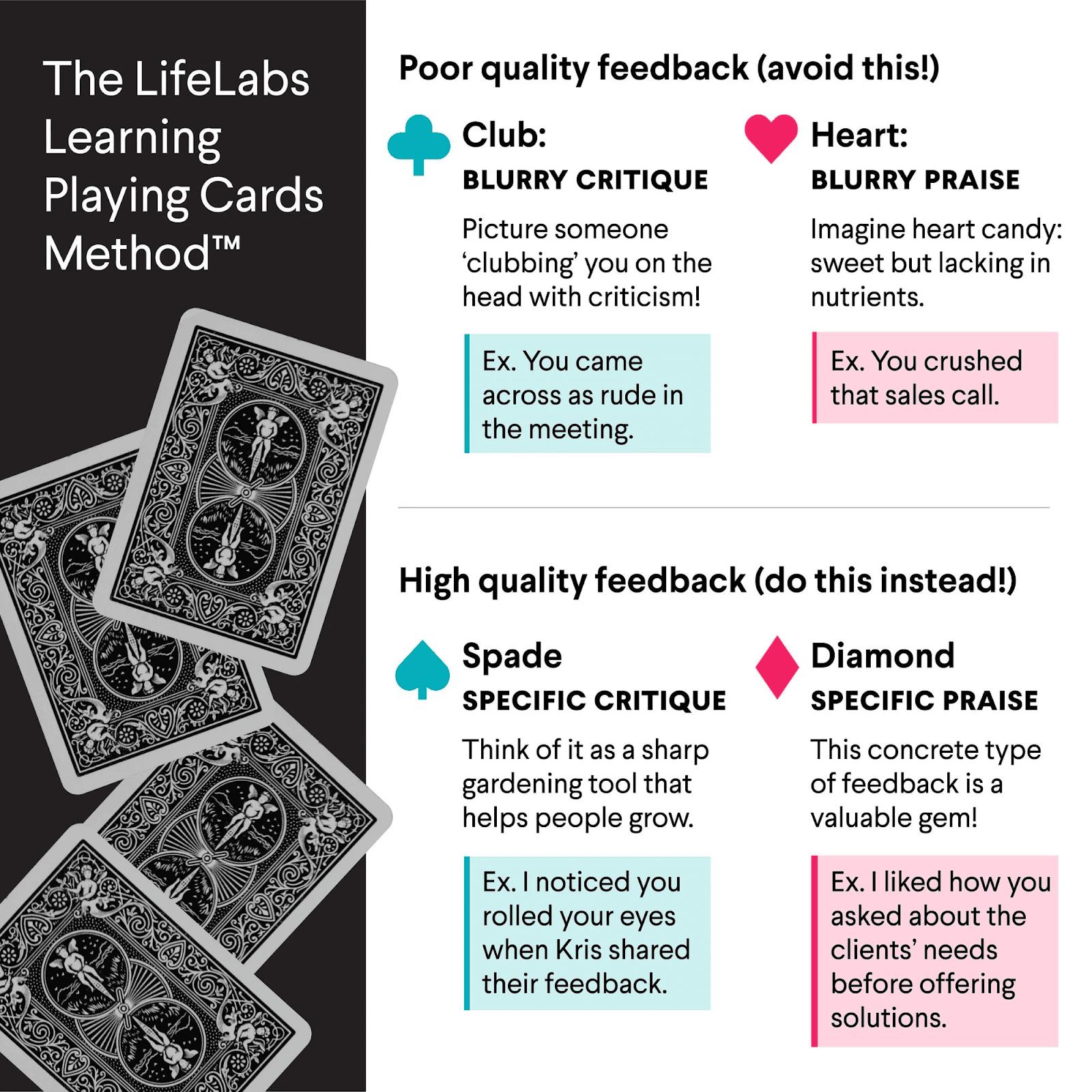
The Playing Cards Method gives people a simple vocabulary for different types of feedback.
Each suit represents a different kind of comment.
Clubs are blurry critiques: “You seem really frustrated.”
That’s unclear and based on interpretation. It doesn’t tell someone what behavior led you to that conclusion.
Spades are specific critiques: “When I asked you to clarify what you meant during our meeting, you sighed loudly.”
Now the person knows exactly what behavior you observed.
The two other suits are about praise.
Hearts are blurry praise: “Awesome presentation.”
That might feel good, but it doesn’t help someone repeat the behavior.
Diamonds are specific praise: “The slide deck on your presentation kept me engaged the whole time, because it added to what you were saying.”
Diamonds usually take a few more words, but they show someone exactly what to keep doing.
Q: Can you share an example of how The Playing Cards Method works in practice?
Kathy
I once worked with a manager who wanted to tell a recruiter he wasn’t approachable enough at hiring fairs.
I told her that sounded like a Club and asked what behavior she wanted him to change. She couldn’t answer. She kept saying, “He just needs to be friendlier.”
Looking at the situation through the Clubs and Spades framework helped her realize something important. Until she could name the behavior she wanted to see, she wasn’t ready to give the feedback. She needed to understand the path forward before she could help him follow it.
Q: Many leaders are using AI to draft feedback. What risks come with relying on it too heavily?
Kathy
Okay, truth time. I did this myself recently. I needed to give feedback and felt rushed, so I asked AI to draft it. When I read the message, something felt off, but I couldn’t put my finger on it.
I had someone else read it, and they immediately pointed out the issue. Once they named it, I realized the tone didn’t feel right.
I advise people to think through their goal for the conversation and what they’ve observed before using AI. Get clear in your own mind first. Then use AI later to polish the message or check for bias.
Using AI as a final step instead of the first step can lead to better feedback.
Q: If someone does use AI to help structure feedback, how can they keep it authentic?
Kathy
Again, your voice has to come first. We can all spot AI-written messages a mile away and the tone is just not authentic.
Really think about the person you’re giving the feedback to. Consider what they need from the conversation and how you would best communicate it as a human being who already has a relationship with them. Then you can put it into AI to check for bias or see what you might add or polish.
Q: Where might AI-generated feedback unintentionally reduce trust or clarity?
Kathy
AI can reflect the same biases that humans bring into feedback. For example, studies show women receive about 25% more personality-based feedback than men. If those patterns exist in the data, AI may repeat them.
The interesting thing is that AI can also help us notice these patterns. You can give AI anonymized feedback examples from across your team and ask it to look for trends. Who receives specific feedback? Who gets vague praise? Who rarely gets recognition?
You can also ask AI to help you build trust and spot possible bias in your feedback. Try asking: “Where might I be expecting something from this person that I wouldn’t expect from someone else?”
Q: The Playing Cards Method emphasizes specificity. Why is that especially important in an AI-influenced workplace?
Kathy
The specificity learned through Diamonds and Spades can improve all conversations, not just feedback. When you’re giving direction, delegating work, or discussing plans or problems, the more specific you get, the clearer it is for everyone.
It’s also important when discussing AI itself. I often hear managers say they’re worried about employees using AI. AI is a powerful tool we should all be using. Let’s normalize talking about it. We should be specific about where AI is helpful and where it isn’t appropriate.
Q: If you could give leaders one piece of advice about balancing AI efficiency with human trust, what would it be?
Kathy
Think carefully about where AI belongs at the table. Are there times when it shouldn’t be at the table?
Ask, “Where will AI be useful here? Where will it be harmful? And what are the things that I need to lead with humanity on and not let AI get involved?”
The real leadership habit is learning to use AI intuitively while also pausing to ask whether it’s the right tool for that moment.