Summary: Constructive feedback is one of the most powerful tools for improving performance, boosting morale, and shaping workplace culture. In this guide, you’ll learn how to give actionable feedback using LifeLabs Learning’s Playing Cards Method™, build a strong feedback culture, and use science-backed techniques to make your feedback more receivable, balanced, and effective.

Why feedback at work matters
We talk a lot about feedback at LifeLabs Learning. Why? Because it’s one of the most (if not the most) essential skills for effective leadership. In fact, 96% of employees say getting regular feedback is beneficial. That’s why we weave feedback into every learning program we offer.
Through our research with over 2,000 companies, we’ve discovered the habits of leaders who excel at feedback. These findings, paired with hundreds of peer-reviewed studies, allowed us to determine the specific behaviors that make feedback effective. These make up the core of our Feedback Skills workshop – our most popular offering!
Here are the key takeaways on giving fantastic feedback at work
Feedback must be receivable – it needs to break through the recipient’s defenses.
Feedback must be actionable – it’s not enough to be heard, it has to drive action.
Feedback must be balanced – there has to be the right mix of praise and critique.
In this blog, we share our top tool for making feedback actionable, clear, and easy to remember. Meet The Playing Cards Method™.
The best way for managers to give constructive feedback at work
Make feedback actionable and transparent
Research shows that only half of employees consistently act on the feedback they’re given at work. For feedback to truly drive improvement, the receiver must understand exactly what behavior to change or continue. In other words, what should they do more or less of? This sounds simple, but giving high-quality, actionable feedback is a skill that takes practice.
That’s why we teach The Playing Cards Method™. This memorable framework helps people quickly distinguish between high-quality (actionable) and low-quality (vague) feedback. Once employees can spot the difference, their feedback becomes more clear and impactful, leading to better performance. A 2025 report highlights that 92% of employees believe receiving constructive feedback positively impacts their performance.
How the Playing Cards Method™ works: Key components of a successful feedback model
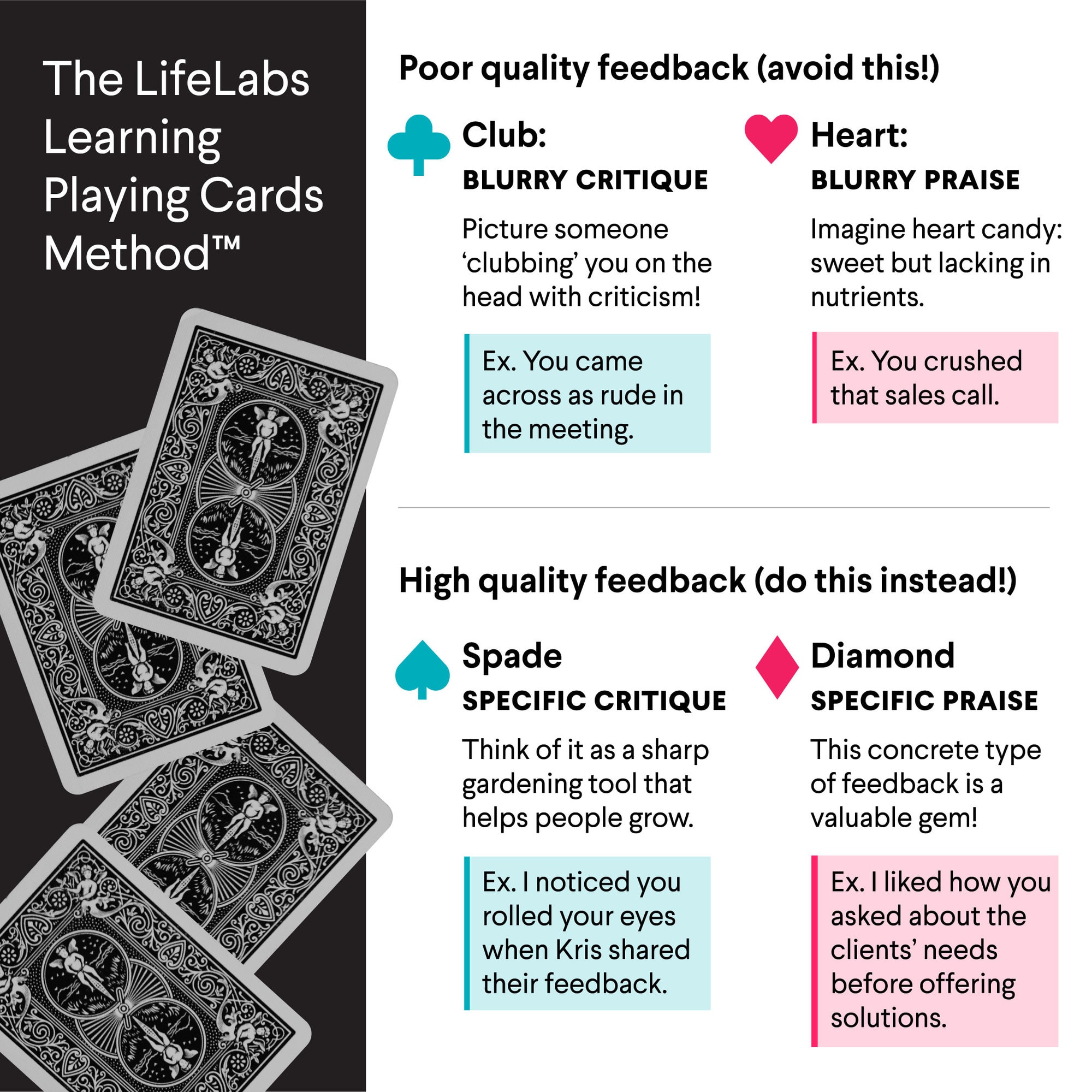
This LifeLabs Learning method uses playing cards to represent different types of feedback: actionable (specific) and non-actionable (vague).
Actionable feedback =
♠️ Spades for critique (helpful tools for digging out the root issues)
♦️ Diamonds for praise (bright, valuable gems)
Non-actionable feedback =
♣️ Clubs for critique (like being hit over the head with unclear criticism)
♥️ Hearts for praise (sweet but lacking substance)
The core difference between the two? Specificity. Actionable feedback is specific, while non-actionable feedback is vague. Here are some examples:
When giving critiques
♣️ CLUB (blurry critique): You came across as rude in the meeting.
♠️ SPADE (specific critique): I noticed you rolled your eyes in the meeting. I mention it because I didn’t feel comfortable sharing my perspective.
When giving praise
♥️ HEART (blurry praise): You crushed that sales call.
♦️ DIAMOND (specific praise): I liked how you asked about the client’s concerns. It helped us come up with an idea that met her needs.
By focusing on giving Spades (specific critique) and Diamonds (specific praise), you provide feedback that truly helps people improve. Check out this video to see it in action!
Tips for giving constructive feedback that drives results
- Start your feedback conversations by getting a Micro-Yes™ to signal a two-way conversation and give folks a chance to prepare (ex: Can we do a quick check-in on…? Do you have some time to talk about…?)
- Be specific by naming what you saw or heard (think of what a camera can pick up! 📸)
- Offer clear examples or data points
- Avoid Blur Words™ – words that can mean different things to different people
Embedding actionable feedback into your culture
Share this approach widely to make feedback part of your company’s DNA. Incorporate The Playing Cards Method™ into your training, onboarding materials, employee handbooks, and any feedback-related resources. This not only builds awareness but also gives employees a shared language to make giving and receiving feedback easier and more effective.
Try this: Card counting
What type of feedback is most common in your company? Pay attention to the “suits” people use in everyday conversations and public forums like Slack or meetings. Spotting patterns in your feedback culture can help you celebrate what’s working and address areas that need improvement (like too many Clubs or Hearts).
Want to unlock even more feedback-giving secrets? In our Feedback Skills Workshop, we teach managers how to deliver receivable, actionable, and balanced feedback that drives results.

FAQs:
How can I provide constructive feedback that drives results?
Be specific, use observable behaviors, and aim for Spades and Diamonds using the Playing Cards Method™.
How do I build a strong feedback culture in my company?
Embed shared language and tools into daily workflows and model feedback behaviors at all levels.
What is the best way to give constructive feedback?
Start with a Micro-Yes™, name what you observed, and explain the impact.
How can managers encourage more transparent feedback?
Normalize feedback moments, avoid vague praise or critique, and create psychological safety
What are the key components of a successful feedback model?
Receivable, actionable, and balanced feedback practices, delivered often and modeled from the top.