Summary: When decisions move faster than explanations, trust becomes fragile. This article shares three practical micro-habits managers can use to build trust in times of uncertainty, especially during AI rollouts and rapid change. These habits focus on clarity, shared learning, and listening before acting.

Leaders are being asked to move faster than they can explain themselves. Amid the many changes people are navigating right now, from restructures and layoffs to new tools and new ways of working, explanations often lag behind decisions.
In a live discussion between LifeLabs Vice Chair Priscila Bala and Ethena Chief People Officer Melanie Naranjo, Melanie shared an example from an AI rollout. Early on, Ethena moved quickly with teams testing new tools and figuring out what was useful as they went. In hindsight, she noted that not sharing expectations around experimentation added fear and uncertainty to the process.
“It’s not the fact that we threw spaghetti at the wall that was the problem,” Melanie said. “It’s the fact that we didn’t give the right context when we were throwing spaghetti at the wall.”
Context matters when it comes to building trust in the AI workplace. Without it, people fill in the gaps themselves, making assumptions about why decisions were made, hesitating to ask questions, and worrying about job security.
Providing context when things are uncertain builds trust, which Priscila calls the true currency of high-performing teams. In a recent blog, she named trust as one of three trends redefining leadership and learning in 2026.
However, trust rarely gets built in a single announcement or a well-crafted message. It’s shaped in the smaller, everyday moments: how a leader explains a half-made decision, how they respond to a question that slows things down, or how clearly they name what’s still being figured out.
Managers can use the three micro-habits and corresponding LifeLabs behaviors below to build trust in times of uncertainty, especially when decisions are moving fast.
Micro-Habit #1: Say what you do and don’t know
When leading change, managers often feel pressure to project certainty. The result is usually the opposite of what they intend. During the Ethena rollout, some of the tension came from not clearly saying, “This is an experiment, and failure is expected.” Without that clarity, people assumed more had been decided than actually was.
A trust-building move is to name what you know right now, what’s still unfolding, and when you plan to revisit it. Naming these things cuts down the mental noise. People stop guessing what’s fixed and what’s still open, and can put their energy where it truly matters.
That clarity helps teams stay engaged, ask better questions, and move forward without fear.
| Try this LifeLabs behavior: Vulnerability Loops People watch leaders closely for cues about what’s safe to say out loud amid uncertainty. Vulnerability Loops build trust by showing it’s okay to name what isn’t clear yet. When a leader goes first by sharing a vulnerability, it lowers the risk for others to speak honestly. Try it: In your next meeting, name one thing you feel unsure about and then pause. Notice what people add once the door is open. |
Micro-Habit #2: Normalize social learning
When leaders normalize social learning, people share what they’re exploring, talk about what’s working and what isn’t, and build on each other’s progress. Over time, that shared learning becomes a clear signal that it’s safe to experiment and grow together.
At Ethena, this showed up as an AI tips-and-tricks channel where employees shared how they use tools in their day-to-day work. Early on, they also ran short AI show-and-tell sessions at all-hands meetings, where a volunteer highlighted an interesting way they were using AI.
Melanie said, “The beauty of it was that we learned that just because this is good for you in Marketing doesn’t mean it’s only a marketing tool. It could help you in HR. It could help you in Sales. We were learning so much faster by sharing things openly instead of trying to figure things out in a silo.”
| Try this LifeLabs behavior: Fail Forward People are constantly assessing risk. When something doesn’t work, the unspoken question is, “Will this be held against me?” Fail Forward builds trust by making it clear that missteps are a source of learning, not a mark against someone. Try it: After something doesn’t go as planned, ask a group: “Was this an experiment that taught us something, a system that needs fixing, or a follow-through issue we can improve?” Then name one small adjustment you’ll make next time. |
Micro-Habit #3: Pull for perspective before you push a plan
When things are shaky, leaders often feel pressure to move quickly to solutions. When that happens, change can start to feel like something happening to people rather than something they’re shaping together.
A trust-building habit is pulling for perspective before pushing a plan. When leaders take time to understand where people are starting from and what they actually need, teams feel seen rather than managed. That understanding leads to better decisions and prevents resistance from building in the background.
In our conversation with Melanie, Priscila emphasized the value of listening first amid AI-driven change. Before deciding on next steps like training or upskilling, she recommended talking with people across roles, levels, and comfort zones to get a sense of what was happening on the ground. She suggested asking questions like, What certainty do they need?, What are they anxious about?, and What would better look like?
| Try this behavior: Pull for Feedback Trust grows when people see that leaders listen before making decisions about change. Pulling for Feedback from others can make change initiatives more collaborative. Try it: After a meeting or early decision, ask two or three people a an open-ended question, like:“What part of this feels unclear?” or “What would help you take the next step from where you are right now?” Listen without correcting or defending. Then use what you hear to shape what comes next. |
None of these micro-habits requires perfect answers or extra time. They work to change how leaders behave while things are still in motion. In times of uncertainty, especially in AI-driven change, trust is built through small, observable behaviors. The leaders who practice them make it easier for teams to stay engaged, speak honestly, and move forward together, even when the path isn’t fully clear.
These are just a few of the leadership behaviors LifeLabs Learning helps managers develop to build trust in times of uncertainty.
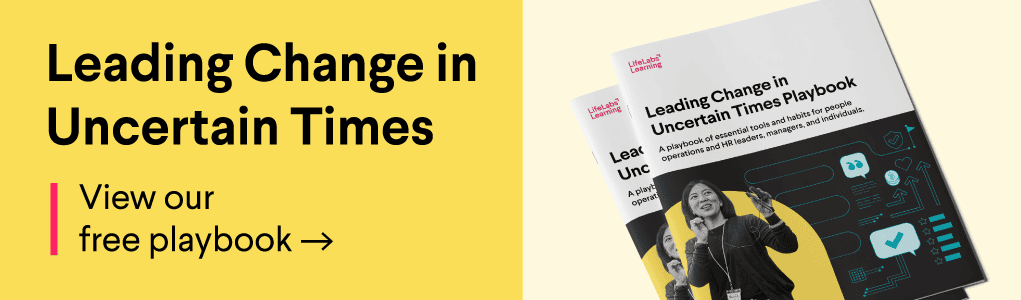
Download our Leading Change in Uncertain Times Playbook for more organizational change management skills and strategies.
FAQ: Building Trust in Times of Uncertainty
Why is trust so important during AI and organizational change?
When decisions move quickly and context is limited, people rely on trust to decide whether to speak up, experiment, or hold back. Without trust, learning slows, and fear fills the gaps.
How can managers build trust when they don’t have all the answers?
By naming what they know and don’t know, listening before acting, and making learning visible. Trust grows from clarity and consistency, not certainty.
What are micro-habits in leadership?
Micro-habits are small, repeatable behaviors, often in everyday conversations, that shape how safe, supported, and engaged teams feel over time.
How do these habits support a human-centered culture in the age of AI?
They make decision-making more transparent, reduce fear around experimentation, and reinforce that human judgment and learning still matter alongside new tools.